OSMO: Open-vocabulary Self-eMOtion Tracking
Dec 8, 2025·,,,,,,,·
1 min read
Mohamed Abdelfattah
Bugra Tekin
Fadime Sener
Necati Cihan Camgoz
Eric Sauser
Shugao Ma
Alexandre Alahi
Edoardo Remelli
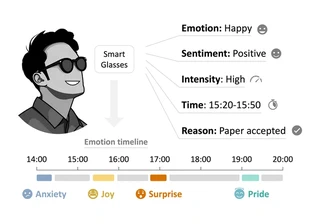
A CVPR 2026 submission introducing a new task, benchmark, and model for open-vocabulary self-emotion tracking from egocentric multimodal streams.
Abstract
We introduce the novel task of egocentric self-emotion tracking, which aims to infer an individual’s evolving emotions from egocentric multimodal streams such as voice, visual surroundings, semantic subtext, and eye-tracking signals.
To establish this research direction, we present:
- OSMO dataset, a large-scale annotation effort on 110 hours of existing bilingual smart-glasses recordings, establishing the largest egocentric emotion dataset and the first with subject-wise emotion timelines.
- OSMO benchmark, a suite of five tasks (emotion recognition, sentiment, intensity, localization, and reasoning), that redefine emotion understanding as a continuous, context-aware process rather than discrete classification of trimmed videos.
- OSIRIS, a large multimodal model that tracks emotions over time by reasoning over the user’s personal emotion history, current expressions, and egocentric observations.
Extensive evaluations show that OSIRIS achieves state-of-the-art performance, delivering, for the first time, coherent emotion timelines from egocentric data. Dataset, model, and code will be fully open-sourced upon publication.
Submission Metadata
- Submission date: 08 Dec 2025
- Last modified: 11 Dec 2025
- Track: Conference, Senior Area Chairs, Area Chairs, Reviewers, Authors
- License: CC BY 4.0
- Subject Area: Datasets and evaluation
- Student Paper: Yes
- Keywords: Self-emotion tracking, emotion recognition, Multimodal Large Language Model, Multimodal learning